
NLP
Turn text into intelligence.
Turn documents, conversations, and unstructured text into structured data you can act on.
50K+ documents processed per day

What you get
Intelligent Document Processing
Extract structured data from contracts, invoices, medical records, and legal filings with layout-aware models and validation pipelines.
Named Entity Recognition
Domain-specific entity extraction for people, organizations, products, medical terms, and custom entity types from any text corpus.
Sentiment & Opinion Analysis
Real-time sentiment engines for customer feedback, social media, reviews, and support tickets with aspect-level granularity.
Semantic Search
Vector-based search that understands meaning, not just keywords. Hybrid retrieval combining dense embeddings with sparse methods.
Conversational AI
Domain-specific chatbots and virtual assistants trained on your knowledge base for customer support, HR, and internal tooling.
Text Classification
Multi-label document classification, topic modeling, intent detection, and content categorization at scale.
Built with
Who this is for
We work with teams sitting on large volumes of unstructured text that currently flows through manual review.
Legal & Compliance
Contract clause extraction and automated risk flagging.
HR Tech
Automating resume screening and job description matching.
Healthcare
Processing clinical notes and patient feedback at volume.
Financial Services
Analyzing earnings call transcripts and support interactions.
E-Commerce & SaaS
Semantic search that understands real user intent.
How we deliver
- Phase_01
Data & Domain Audit
We analyze your text data (volume, language, domain vocabulary, quality) and define what structured output you need.
- Phase_02
Pipeline Design
Architecture for preprocessing, model selection, post-processing, and validation. Every pipeline is modular and testable.
- Phase_03
Model Training & Tuning
Fine-tuning transformer models on your domain data with rigorous evaluation on precision, recall, and real-world accuracy.
- Phase_04
Integration & Monitoring
API deployment, batch processing setup, drift detection, and continuous improvement based on production feedback.
Questions we hear
Yes. For multilingual classification, NER, and semantic search, we use multilingual transformer models -- XLM-RoBERTa and mBERT handle 100+ languages with strong performance on European and major Asian languages. Arabic, Hindi, and other morphologically complex languages typically need domain-specific fine-tuning on top of the multilingual base.
For text classification with a fine-tuned transformer, 500-2,000 labeled examples per class is usually enough for production quality. Named entity recognition needs 1,000-5,000 annotated sentences. If your labeled data is thin, we combine semi-supervised learning with active learning loops so you label efficiently rather than randomly.
Traditional NLP with fine-tuned transformers is faster, cheaper, and more deterministic -- ideal for high-volume classification, entity extraction, and structured output. LLMs handle ambiguous, open-ended tasks better but cost 10-50x more per token. Many of our production systems combine both: a fine-tuned classifier routes text, with an LLM handling only the cases that benefit from reasoning depth.
A classification or NER pipeline integrated into an existing API takes 4-8 weeks. Semantic search built on a document corpus takes 2-4 weeks. Document extraction from structured layouts runs 4-6 weeks. Conversational AI on a domain knowledge base takes 6-10 weeks. The biggest variable is labeled data availability at project start.
For binary classification on clean text, well-tuned models reach 90-97% F1. Multi-label classification over 20+ categories runs 80-88% micro-F1. NER on domain-specific entities reaches 85-93% F1 after fine-tuning. We report precision and recall separately because the right tradeoff depends on your use case.
Work in Natural Language Processing

Valfile Recruitment Platform
Intelligent recruitment platform that automates resume screening, job description matching, and candidate ranking using NLP pipelines.

AI Data Assistant
Natural language interface that converts plain English questions into database queries and visualizations.
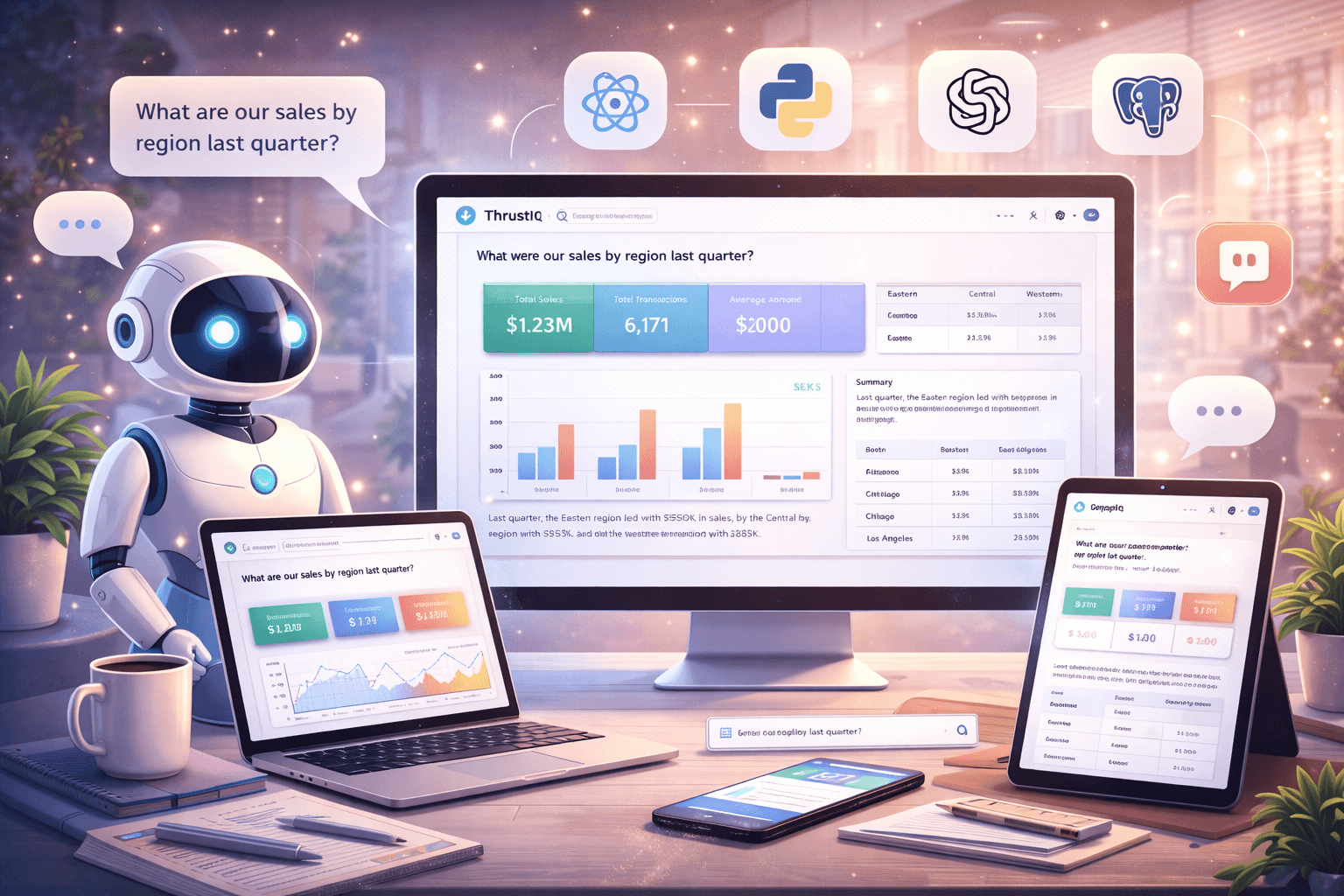
ThrustIQ Analytics
Conversational BI platform turning natural language into actionable data insights.

AI Sales Trainer
NLP-powered conversation analysis scoring sales call performance and extracting coaching insights.
Related Services

Generative AI
RAG pipelines, autonomous agents, and voice AI that ship to production and improve over time.
- RAG Systems
- Autonomous AI Agents
- Voice AI Agents
- LLM-Powered Products

Computer Vision
Detection, classification, segmentation, OCR, and video analytics. Production systems with real-time inference and edge deployment.
- Object Detection & Tracking
- Image Classification
- Segmentation
- Video Analytics
Next step
Sitting on unstructured data?
Documents, conversations, support tickets. We turn text into structured intelligence.