
Data Engineering
Build the data foundation.
Pipelines, warehouses, and real-time dashboards. The data infrastructure your ML models need to work.
2M+ events processed per day
What you get
ETL/ELT Pipelines
Automated data extraction, transformation, and loading from APIs, databases, files, and streaming sources. Batch and real-time processing with fault tolerance.
Data Warehouses
Modern analytical storage on Redshift, Snowflake, or Delta Lake. Star schema design, partitioning strategies, and query optimization.
Real-Time Streaming
Event-driven architectures with Apache Kafka and Kinesis. Sub-second latency for live dashboards, alerting, and real-time ML inference.
Analytics Dashboards
Interactive BI dashboards using Metabase, Superset, Grafana, or custom React dashboards with real-time data feeds.
Data Quality & Governance
Automated validation, schema enforcement, lineage tracking, and anomaly detection using Great Expectations and dbt tests.
Geospatial Processing
Specialized pipelines for geographic data: tile generation, coordinate transforms, heatmaps, and spatial indexing with PostGIS and H3.
Built with
Who this is for
We work with data and engineering teams where the data infrastructure has become the bottleneck: pipelines are fragile, dashboards are stale, or the ML team can't get clean training data.
Fintech
Ingesting high-frequency market and transaction data that has to stay accurate in real time.
E-Commerce
Real-time inventory and recommendation feeds that keep storefronts current.
Logistics
Tracking GPS and sensor event streams across fleets and supply chains.
Scaling Startups
Teams that have outgrown spreadsheets and ad-hoc scripts and need real infrastructure.
How we deliver
- Phase_01
Audit & Strategy
We assess your current data landscape, identify gaps, and design a target architecture aligned with your analytics and ML goals.
- Phase_02
Pipeline Architecture
Modular, testable pipeline design using infrastructure as code. Every pipeline is version controlled, monitored, and documented.
- Phase_03
Build & Migrate
Incremental build, test, and deploy. If you are migrating from legacy systems, we handle the transition with zero downtime.
- Phase_04
Scale & Optimize
Query performance tuning, cost optimization, auto-scaling configurations, and proactive monitoring as you grow.
Questions we hear
A focused ETL pipeline connecting 3-5 sources to a single destination runs $12,000-$25,000 to build and test. Larger architectures with real-time streaming via Kafka, multiple transformation layers in dbt, and custom orchestration in Airflow are typically $30,000-$80,000. We quote against a clear architecture diagram, not abstract hours.
A migration from a legacy warehouse to a modern stack typically takes 6-12 weeks. The range depends on how many existing dbt models or transformation jobs need to be ported, data volume, and whether we can use a parallel-run period to validate outputs before cutover.
Batch is simpler and cheaper -- use it when data that's an hour or a day old is fine. Real-time streaming with Kafka or Kinesis makes sense when you need live dashboards, sub-minute alerting, or real-time ML inference. Most businesses benefit from a hybrid: batch for historical analytics, streaming for operational metrics.
A data warehouse (Redshift, Snowflake) is structured, fast for SQL analytics, and the right default for most teams. A data lake stores raw data cheaply and supports ML training pipelines. Most of our clients end up with a lakehouse pattern: raw files in S3, transformed and modeled data in a warehouse, orchestrated by Airflow.
We implement validation at three layers. Source validation catches schema drift and null rate anomalies before data enters the pipeline. Transformation-layer tests in dbt validate business logic. Destination monitoring via Great Expectations flags statistical anomalies. Failed validations trigger Airflow alerts and halt downstream dependencies.
Work in Data Engineering

Ethereum Breakout Prediction
Built a real-time crypto market intelligence platform that ingests and processes market data for short-term price prediction models.

FinTech Forecasting Platform
Automated ingestion and processing pipeline powering ML-driven financial forecasts.
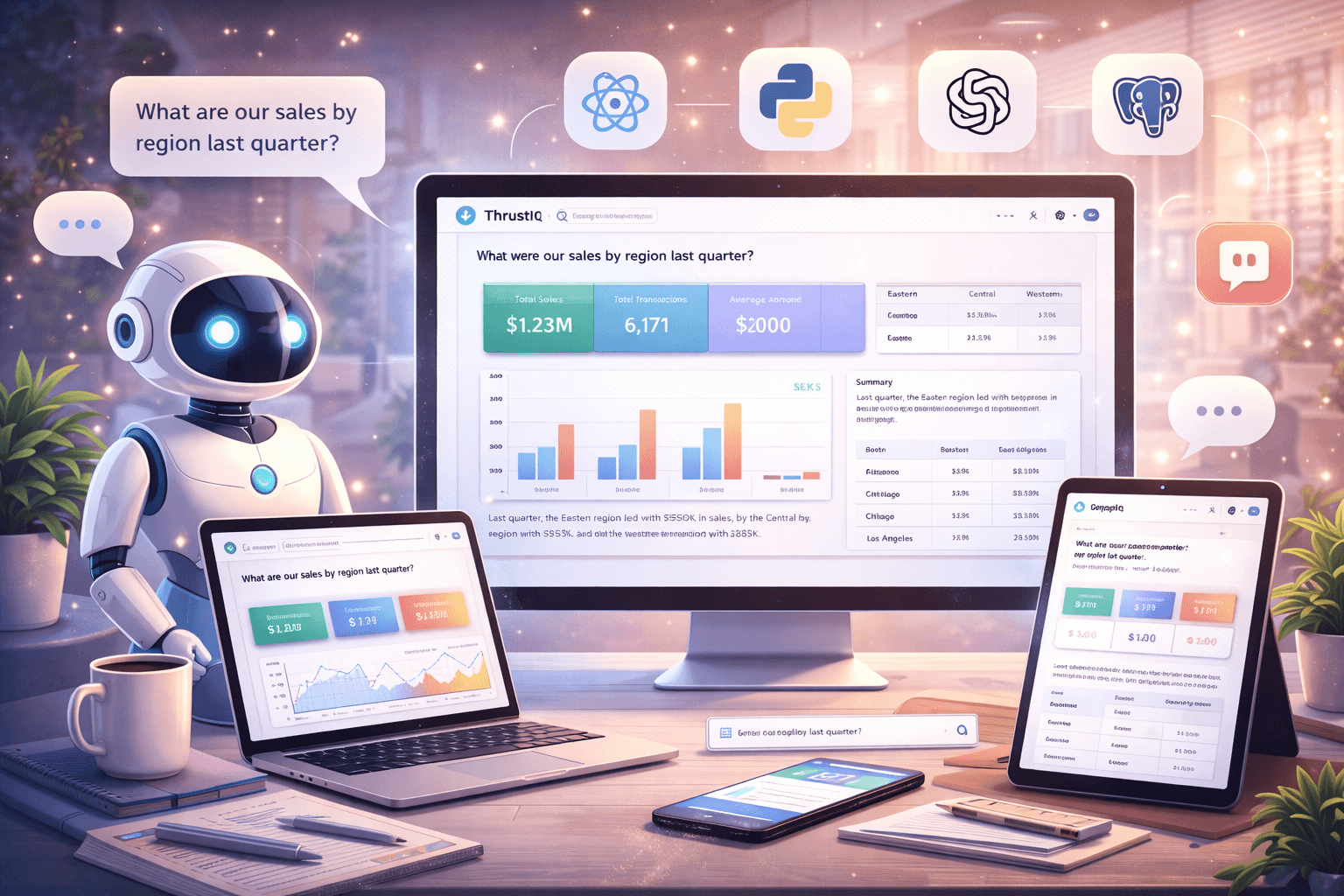
ThrustIQ Analytics
Conversational BI platform turning natural language into real-time data queries.
Related Services

Generative AI
RAG pipelines, autonomous agents, and voice AI that ship to production and improve over time.
- RAG Systems
- Autonomous AI Agents
- Voice AI Agents
- LLM-Powered Products
Computer Vision
Detection, classification, segmentation, OCR, and video analytics. Production systems with real-time inference and edge deployment.
- Object Detection & Tracking
- Image Classification
- Segmentation
- Video Analytics
Next step
Let's build your data infrastructure.
Talk to our engineering team about pipelines, warehouses, and real-time analytics.